Mana Estate BlogHow Much Does Land Cost in Freetown? A Comprehensive 2026 Market Guide to Land Prices Across Freetown and Sierra Leone
August 12, 2026
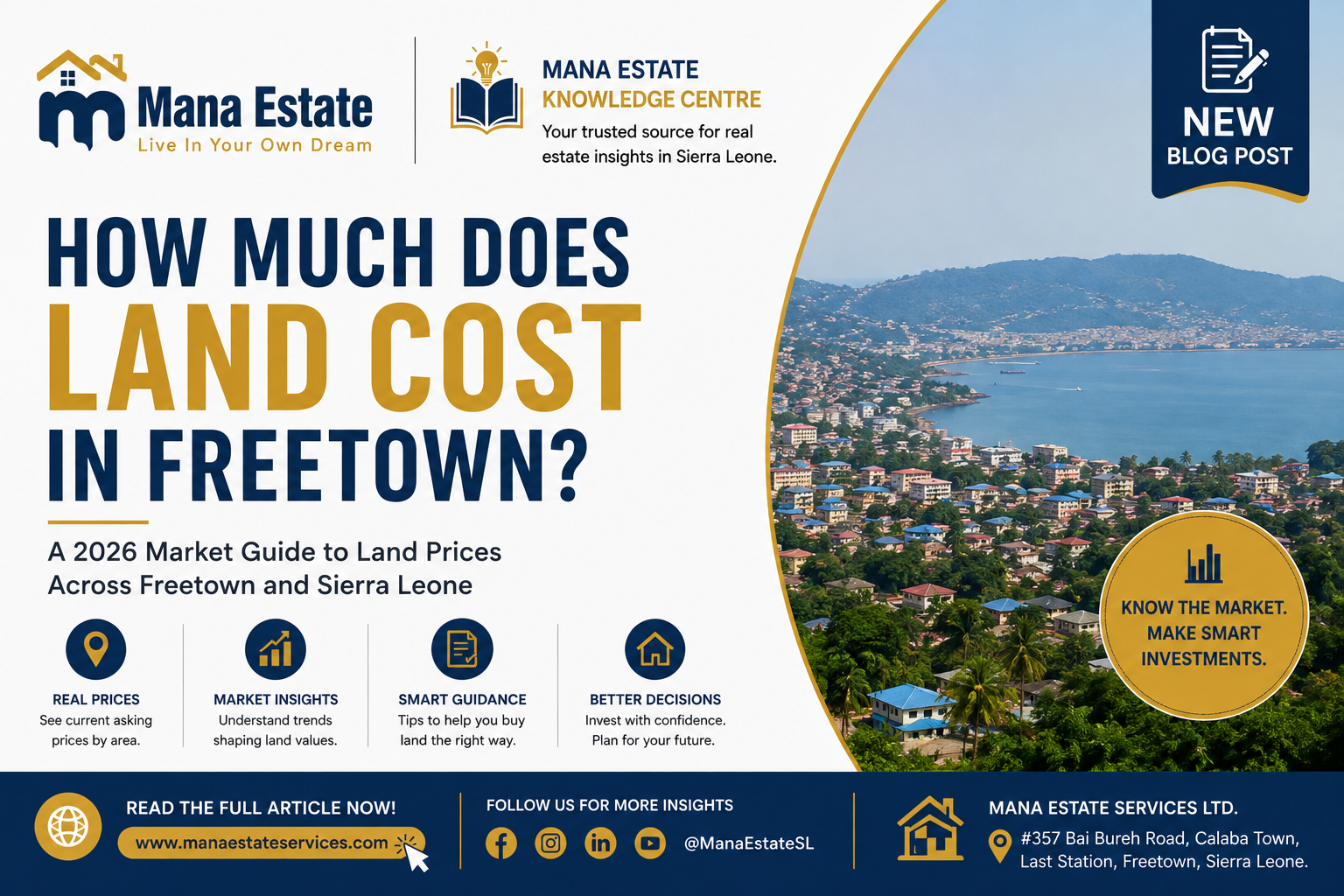 How Much Does Land Cost in Freetown?
A Comprehensive 2026 Market Guide to Land Prices Across Freetown and Sierra Leone
By Hamidu Ansumana
Mana Estate Knowledge Centre
Introduction
One of the questions we hear repeatedly in Sierra Leone's property market is:
"How much does land cost in Freetown?"
There is no single answer.
Land prices can vary dramatically from one neighborhood to another and sometimes from one street to the next. A plot with good road access, electricity, water, drainage, clear documentation and strong development potential can command a significant premium over a similar-sized plot with poor accessibility or unresolved documentation issues.
Unlike markets with centralized databases that publish thousands of completed property transactions, Sierra Leone's land market still has limited publicly available transaction-price data. Buyers, investors and professionals therefore often rely on advertised asking prices, negotiations, professional valuations and local market knowledge.
This article provides a 2026 snapshot of advertised land prices across Freetown and selected parts of Sierra Leone, based on listings published by estate agencies and property platforms.
Important: The prices discussed in this article are asking prices, not confirmed completed sale prices. The final transaction price can be significantly different depending on negotiation, location, documentation, infrastructure and other property-specific factors.
First: What Is a Town Lot?
Before discussing prices, we need to establish what we mean by a "plot" or "town lot."
A commonly used residential town-lot measurement in Sierra Leone is approximately:
75 feet × 50 feet
That's approximately:
3,750 square feet
348 square meters
Ten such town lots are approximately equivalent to one acre.
However, buyers should always confirm the actual dimensions of a property rather than assuming that every advertised "town lot" has exactly the same measurements.
Why Are Land Prices So Different?
Location is important, but it isn't the only factor.
Two properties in the same community can have dramatically different values because of differences in:
Road access
A property directly accessible from a major paved road will generally be more attractive than one accessible only through a narrow or undeveloped road.
Infrastructure
Electricity, water, drainage, telecommunications and other infrastructure can significantly influence property demand.
Topography.
Flat land can be easier and cheaper to develop than steep or difficult terrain.
Documentation.
Land with clear, verifiable documentation generally provides greater confidence to buyers than land with uncertain ownership or incomplete records.
Development potential.
A property suitable for apartments, commercial development, a hotel or other income-generating projects may command a premium over land suitable only for a private residence.
Neighborhood Demand.
Areas experiencing population growth, commercial activity and infrastructure development can attract increasing investor interest.
Proximity to amenities.
Schools, hospitals, shopping centres, beaches, major roads and business districts can all influence land values.
Freetown: Where Is Land Most Expensive?
Freetown has some of the highest land prices in Sierra Leone, particularly in established and premium neighborhoods.
But even within Freetown, there is no uniform price.
Let's look at some of the areas attracting attention.
Aberdeen.
Aberdeen remains one of Freetown's premium residential and commercial locations.
Its appeal comes from its coastal location, established infrastructure, hospitality industry, restaurants, entertainment businesses and proximity to other high-value neighbourhoods.
Advertised listings have placed land in the area around **US$50,000–US$65,000 or more per town lot, depending on the specific location, size, access and development potential.
Some larger parcels have been advertised at approximately US$250,000 for five town lots, equivalent to roughly US$50,000 per town lot.
However, buyers should not interpret these figures as an official Aberdeen market rate. They represent individual asking prices.
Spur Road and Spur Loop.
Spur Road and Spur Loop are among the most sought-after residential areas in Freetown.
The neighborhood attracts high-income residents, expatriates, businesses and investors because of its location, accessibility and established infrastructure.
Some advertised properties have indicated land values around US$70,000–US$75,000 per town lot in premium locations.
Again, the exact value can vary considerably based on frontage, accessibility, documentation and the property's development potential.
Lumley.
Lumley is another major property market within the Western Area.
Its combination of residential development, commercial activity, tourism, restaurants, hotels and proximity to the coastline continues to attract investors.
Prime parcels in Lumley can command US$60,000–US$80,000 or more per town lot in some advertised listings.
However, "Lumley" covers a large area, and prices should not be generalized across the entire community.
A property close to major commercial corridors can have a very different value from one deeper within a residential area.
Congo Town.
Congo Town remains one of Freetown's established residential and commercial neighborhoods.
Advertised land prices in the area have reached approximately US$55,000 per town lot for certain properties.
Its relatively central location and established infrastructure continue to support demand.
Wilkinson Road Corridor.
Wilkinson Road is particularly important because it combines residential and commercial potential.
Properties with good frontage and accessibility can command substantial premiums because they may be suitable for offices, retail businesses, apartments, restaurants and other commercial uses.
Some advertised opportunities have indicated prices of US$70,000 or more per town lot in selected locations.
This is an important example of why land should not be valued based solely on size.
A town lot with strong commercial frontage can have a completely different economic value from a similarly sized residential plot elsewhere.
Goderich.
Goderich offers a different proposition.
The area has residential, coastal and tourism potential, and properties closer to the beach can attract significant interest.
Some advertised beachfront land has been priced around US$30,000 per town lot.
However, beachfront property requires additional due diligence. Buyers should consider coastal conditions, erosion, accessibility, drainage, planning requirements and development restrictions before purchasing.
Tokeh.
Tokeh has increasingly attracted attention from tourism developers, diaspora investors and people looking for coastal properties.
Advertised prices have included approximately **US$15,000–US$25,000 per town lot**, depending heavily on proximity to the beach, accessibility and the size of the parcel.
The area is particularly interesting for investors who are thinking beyond immediate residential use and considering hospitality, vacation homes and tourism-related developments.
Kent
Kent is another location attracting interest along the peninsula.
Some advertised listings have placed land at approximately US$13,500–US$15,000 per town lot.
Its relatively lower entry price compared with prime Freetown locations is one reason investors looking for longer-term opportunities may pay attention to the area.
Regent.
Regent is one of the more interesting emerging markets around Freetown.
Improved accessibility and continued residential development have increased attention toward the area.
Advertised land prices have ranged roughly between US$8,000 and US$45,000 per town lot, depending on location, accessibility and other property characteristics.
For investors, Regent illustrates an important principle:
The best investment opportunity isn't always where land is already expensive. Sometimes it is where infrastructure and development are beginning to catch up with demand.
Waterloo and the Eastern Growth Corridor.
Waterloo has become increasingly important as Freetown's urban footprint expands.
For many buyers, the area provides a lower-cost entry point compared with established Western Area neighbourhoods.
Some advertised listings have placed land around US$7,000 per town lot, although prices vary significantly depending on the exact location, road access, services and documentation.
Investors should distinguish between land that is merely cheap and land that is strategically positioned for future development.
Those are not necessarily the same thing.
Newton and Surrounding Communities.
Newton and surrounding areas have also attracted residential development as the metropolitan area continues expanding.
Land can be considerably more affordable than in prime central Freetown locations.
However, prices vary widely, and buyers should assess each development carefully.
Particular attention should be given to:
Road accessibility
Drainage
Electricity
Water
Existing development
Distance to major roads
Documentation
Future infrastructure
Tombo.
Tombo demonstrates just how wide the range of Sierra Leone's land market can be.
Some large-parcel listings in the area have advertised land from around US$1,500 per town-lot equivalent, while better-positioned or more developed parcels can command considerably more.
This does not mean every plot in Tombo is worth US$1,500.
It illustrates the importance of understanding what exactly is being sold, where it is located, how much land is involved and what rights and documentation accompany the property.
What About Land Outside Freetown?
The land market does not end at the Western Area.
Sierra Leone's provincial cities and districts have their own property markets, and prices are influenced by urban growth, population, commercial activity, agriculture, mining, tourism and infrastructure.
Bo District.
Bo is one of Sierra Leone's largest urban centers and an important commercial hub.
Residential land around Bo City can be considerably more affordable than prime Freetown locations.
However, areas close to established commercial corridors, major roads and expanding residential neighborhoods can command premiums.
For investors, Bo is particularly interesting because it combines urban population growth with a relatively lower entry cost than Freetown.
Kenema District.
Kenema is another important commercial center.
Land demand is influenced by commercial activity, residential expansion and the city's role as an economic center in the Eastern Province.
Prices vary considerably depending on whether the property is located within the established urban area, along major roads or in developing outskirts.
Bombali District and Makeni.
Makeni has developed into an important northern commercial and educational center.
Land around the city and its expanding outskirts can provide lower-cost opportunities compared with Freetown.
Investors should pay particular attention to areas experiencing new residential construction, road improvements and commercial expansion.
Port Loko District.
Port Loko is strategically positioned because of its proximity to Freetown and major transportation corridors.
Infrastructure and economic development can have an important influence on land demand in the district.
As with other emerging areas, investors should distinguish between land that has genuine development potential and land that is simply being marketed as an "investment opportunity."
Kono District.
Kono's property market is strongly influenced by its economic activity, particularly mining.
Land values can vary substantially between established urban areas and more remote locations.
Investors should carefully evaluate the sustainability of demand and the intended use of the property before purchasing.
Moyamba and the Southern Region.
Moyamba and other parts of the Southern Province offer opportunities at significantly different price points from central Freetown.
Coastal locations and areas with tourism potential can command premiums compared with inland agricultural land.
Again, location, access, documentation and development potential remain critical.
Freetown vs. the Provinces.
The biggest lesson from comparing Freetown with the districts is that Sierra Leone does not have one national land price.
There are multiple interconnected property markets.
A town lot in Aberdeen cannot realistically be compared directly with a town lot outside Makeni.
The land may be the same size, but the economic environment surrounding it is completely different.
A more useful question is:
What can this particular piece of land realistically become, and what is the market willing to pay for that potential?
Asking Price Is Not Market Value
This distinction is extremely important.
If an agent advertises a plot for US$50,000, that does not automatically mean the property is worth US$50,000.
It means the seller is asking US$50,000.
The eventual transaction may occur at:
US$45,000
US$40,000
US$50,000
Or potentially higher
depending on the circumstances.
A formal valuation is a different exercise from simply looking at advertisements.
This is why Mana Estate recommends comparing multiple properties and seeking professional advice before relying on a quoted price.
Why Online Listings Can Be Misleading
Property advertisements can sometimes leave out important information.
For example, a listing might advertise:
"Land for sale US$10,000."
But the buyer may later discover that:
The property is far from the main road.
There is no electricity.
Access is difficult during the rainy season.
The land requires substantial filling.
Documentation is incomplete.
The advertised price is for a fraction of the property.
Additional fees apply.
Therefore, never make an investment decision based on the headline price alone.
What Should You Check Before Buying?
Before paying for land, investigate at least the following:
1. Ownership
Who actually owns the land?
2. Documentation
What documents support the seller's claim?
3. Boundaries
Do the physical boundaries correspond with the documentation?
4. Access
Does the property have legal and practical road access?
5. Drainage
What happens during heavy rainfall?
6. Utilities
Is electricity and water available or realistically accessible?
7. Development potential
What can legally and practically be built there?
8. Surrounding development
Are homes, businesses and infrastructure expanding into the area?
9. Disputes
Are there competing claims or boundary issues?
10. Total acquisition cost
What will the land actually cost you after professional, documentation, surveying and development-related expenses?
Where Are the Opportunities?
From an investment perspective, the most interesting opportunities are not necessarily the areas with the cheapest land.
Investors should look for the intersection of:
Affordable Entry Price + Improving Infrastructure + Growing Demand + Secure Documentation + Development Potential
That combination is far more meaningful than simply finding the lowest price.
For example, an investor may buy a cheap plot in an area that remains inaccessible and undeveloped for decades.
Another investor may pay more for land in an emerging corridor where roads, electricity, housing and commercial activity are expanding.
The second investor may ultimately achieve the better return.
What Could Push Land Prices Higher?
Several factors could influence Sierra Leone's land market over the coming years.
Infrastructure investment
Roads and transportation networks can dramatically change accessibility and therefore property demand.
Urban expansion.
As Freetown continues to expand, surrounding communities may experience increased demand.
Diaspora investment
Sierra Leoneans living abroad remain an important source of property investment.
Tourism
Coastal areas with strong tourism potential could experience increasing demand for hospitality and residential development.
Population growth
More households require more housing, which creates demand for land and development.
Commercial activity
New businesses and employment centers can create demand for nearby residential and commercial property.
So, How Much Should You Budget?
If you are looking to purchase land in Sierra Leone, there is no single budget that works for everyone.
For a buyer seeking a premium Freetown location, the budget may need to be tens of thousands of US dollars per town lot.
For someone willing to look toward emerging communities, the entry point can be significantly lower.
For investors looking outside Freetown, opportunities may exist at even lower prices, although the trade-off can be infrastructure, liquidity, distance from major economic centers and development timelines.
The question therefore isn't simply:
"How much money do I need to buy land?"
A better question is:
"What type of land can I afford, where should I buy it, and what do I expect that land to do for me?"
The Mana Estate Perspective
Sierra Leone's land market is changing.
Freetown continues to command premium prices in established neighborhoods, while emerging communities and provincial cities provide alternative entry points for investors.
But price alone does not determine whether a property is a good investment.
Location matters.
Documentation matters.
Infrastructure matters.
Accessibility matters.
Demand matters.
And future development matters.
The smartest investors don't simply ask:
"How cheap is this land?"
They ask:
"What am I buying, what risks am I taking, and what could this property realistically be worth in the future?"
That is the mindset we want to encourage through the Mana Estate Knowledge Centre.
Our Market Data Commitment.
This article is intended to become a living market guide, not a one-time publication.
As Sierra Leone's real estate market develops, we intend to update our market snapshots periodically using available advertised listings, professional observations, market participants and other credible sources.
Over time, our goal is to build a more comprehensive picture of property prices across:
Freetown → Western Rural → Bo → Kenema → Makeni → Port Loko → Kono → Moyamba → and other emerging markets.
The long-term ambition is to help create greater transparency in Sierra Leone's property market.
Because investors make better decisions when they have better information.
A Note on the Figures in This Article.
The prices referenced in this article are indicative advertised asking prices gathered from publicly available property listings and should not be interpreted as official market values or completed transaction prices.
Property prices can change rapidly. Individual properties may command substantially more or less than the ranges discussed depending on location, size, access, documentation, infrastructure, topography, intended use and negotiation.
A formal valuation should be obtained where an accurate market value is required for a transaction, financing, accounting, taxation or other professional purpose.
About the Mana Estate Knowledge Centre.
The Mana Estate Knowledge Centre is an initiative of Mana Estate Services Ltd dedicated to educating and empowering buyers, sellers, investors, developers, landlords and property professionals with practical information about Sierra Leone's real estate industry.
Our objective is simple:
Better information. Better decisions. Better investments.
By Hamidu Ansumana
CEO, Mana Estate Services Ltd
Mana Estate Knowledge Centre
Live In Your Own Dream.